
Photodynamic Therapy Market to Reach USD 7.79 Billion by 2031 as Skin Cancer Treatment and Next-Generation Photosensitizers Support Growth
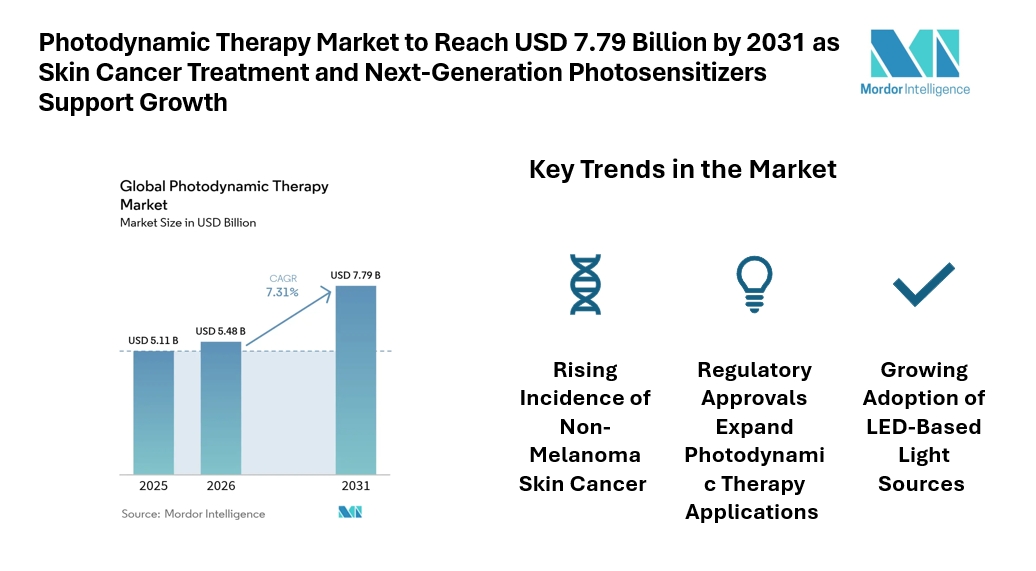
Hyderabad, India – 8 October, 2026 – According to Mordor Intelligence, the photodynamic therapy market size is estimated at USD 5.48 billion in 2026 and is expected to reach USD 7.79 billion by 2031, registering a CAGR of 7.31% during the forecast period. North America currently holds the largest share of the market, while Asia-Pacific is projected to register the fastest growth.
Photodynamic therapy (PDT) uses a photosensitizer drug activated by a specific wavelength of light to produce a therapeutic effect. The approach has traditionally been associated with oncology but is increasingly being used across dermatology, ophthalmology, and antimicrobial applications. Growing clinical acceptance, expanding reimbursement for selected indications, and improvements in light-source technology are supporting the photodynamic therapy market growth.
Report Overview: https://www.mordorintelligence.com/industry-reports/photodynamic-therapy-market?utm_source=abnewswire
Photodynamic Therapy Market Trends
Rising Incidence of Non-Melanoma Skin Cancer
The increasing incidence of non-melanoma skin cancers is supporting demand for less invasive treatment approaches. Photodynamic therapy offers a tissue-sparing option for selected superficial lesions and can provide favorable cosmetic outcomes, making it relevant for lesions in cosmetically sensitive areas.
The growing use of PDT for field cancerization and repeatable treatment protocols is also supporting procedural demand across dermatology practices. This trend is particularly relevant in regions with high skin cancer incidence, including North America and Australia.
Regulatory Approvals Expand Photodynamic Therapy Applications
Regulatory clearances for new photosensitizers and light-delivery systems are broadening the clinical applications of PDT. The expansion of approved technologies into ophthalmology and other therapeutic areas demonstrates the potential for photodynamic therapy beyond its traditional oncology applications.
Next-generation photosensitizers, including formulations designed to improve treatment selectivity and reduce photosensitivity duration, are also receiving greater attention. These developments could support wider clinical adoption and create additional opportunities for the photodynamic therapy industry.
Growing Adoption of LED-Based Light Sources
Light-source technology is becoming an important area of development within the photodynamic therapy market. High-output LED systems can provide wider treatment fields and may reduce equipment costs compared with conventional laser-based systems, supporting their adoption across clinical settings.
The availability of more portable and cost-efficient systems could also help extend PDT beyond large hospitals and specialist centers. AI-supported dosimetry is another emerging area, with automated systems being explored to improve treatment planning and light-dose delivery.
Expanding Reimbursement Supports Clinical Adoption
Reimbursement policies are influencing the adoption of PDT, particularly for established dermatology applications. Dedicated reimbursement pathways and coverage for selected indications can make treatment more economically viable for healthcare providers and patients.
As additional clinical evidence becomes available for non-oncology indications, reimbursement expansion could support broader use of photodynamic therapy. However, coverage remains uneven across indications and geographies, creating a continuing challenge for market participants.
High Equipment Costs Remain a Restraint
The capital requirements associated with PDT laser systems can limit adoption among smaller dermatology practices. Leasing models and lower-cost LED systems are helping address this challenge, although providers must also consider maintenance, calibration, and equipment replacement requirements.
Patient compliance is another consideration because some photosensitizers can cause prolonged sensitivity to light. This can discourage patients from completing treatment protocols and remains an important factor influencing the adoption of particular PDT approaches.
Photodynamic Therapy Market Segmentation
By Product Type
-
Photosensitizer Drugs
-
First Generation
-
Second Generation
-
Third Generation / Targeted Nano
-
Devices & Light Sources
-
Diode Lasers
-
LED Array
-
Other Lamps
Photosensitizer drugs currently represent the larger product category, while LED-based light sources are expected to record strong growth as manufacturers focus on wider treatment fields, lower equipment costs, and improved treatment delivery.
By Application
-
Oncology
-
Non-Melanoma Skin Cancer
-
Actinic Keratosis
-
Head & Neck / Oral Cavity Cancer
-
Lung & Esophageal Cancer
-
Dermatology
-
Ophthalmology
-
Antimicrobial / Aesthetics
Oncology remains the leading application area, while dermatology applications outside cancer treatment are expanding the addressable market. Ophthalmology is also gaining relevance following regulatory clearance of PDT-related systems for selected eye conditions.
By End User
-
Hospitals
-
Dermatology & Skin-Cancer Clinics
-
Ambulatory Surgical Centers
-
Research & Academic Institutes
Hospitals account for the largest share because of their ability to manage complex cases and invest in specialized treatment equipment. Ambulatory surgical centers are expected to record faster growth as outpatient treatment models gain traction.
By Geography
-
North America: United States, Canada, and Mexico
-
Europe: Germany, United Kingdom, France, Italy, Spain, and Rest of Europe
-
Asia-Pacific: China, India, Japan, South Korea, Australia, and Rest of Asia-Pacific
-
South America: Brazil, Argentina, and Rest of South America
-
Middle East and Africa: GCC, South Africa, and Rest of Middle East and Africa
Photodynamic Therapy Market Competitive Landscape
The photodynamic therapy market share is distributed among pharmaceutical companies, medical device manufacturers, and specialized PDT technology providers. Competition is centered on photosensitizer development, drug-device combinations, light-source technology, treatment efficiency, and expansion into additional therapeutic indications. Mordor Intelligence characterizes the market as moderately concentrated.
Key Players
-
Biofrontera AG
-
Lumibird (Quantel Medical)
-
Sun Pharmaceutical Industries Limited
-
Galderma S.A.
-
Bausch Health Companies Inc.
-
Modulight Corporation
-
Theralase Technologies Inc.
-
Lumenis
-
AngioDynamics Inc.
-
DUSA Pharmaceuticals Inc.
-
Cynosure LLC
-
Bio-Litec AG
-
Quest PharmaTech Inc.
-
Sciton
-
TopLight Photonics Co. Ltd.
Companies are focusing on proprietary photosensitizers, dedicated illumination platforms, targeted formulations, and treatment-planning technologies to strengthen their positions in the photodynamic therapy industry.
For more insights on the Japanese market report, please visit the Mordor Intelligence page: https://www.mordorintelligence.com/ja/industry-reports/photodynamic-therapy-market?utm_source=abnewswire
Conclusion
The photodynamic therapy market forecast indicates continued expansion as the therapy gains wider acceptance across oncology, dermatology, ophthalmology, and other clinical applications. Rising skin cancer incidence, new regulatory approvals, improving light-source technology, and greater reimbursement for selected indications are supporting demand.
North America is expected to maintain its leading position, supported by established healthcare infrastructure, reimbursement mechanisms, and high skin cancer incidence. Asia-Pacific is projected to experience the fastest growth as clinical protocols become more standardized, healthcare infrastructure improves, and cost-effective light-source technologies become more available.
Media Contact
Company Name: Mordor Intelligence Private Limited
Contact Person: Jignesh Thakkar
Email: Send Email
Phone: +1 617-765-2493
Address:11th Floor, Rajapushpa Summit, Nanakramguda Rd, Financial District, Gachibowli
City: Hyderabad
State: Telangana 500008
Country: India
Website: https://www.mordorintelligence.com/


